
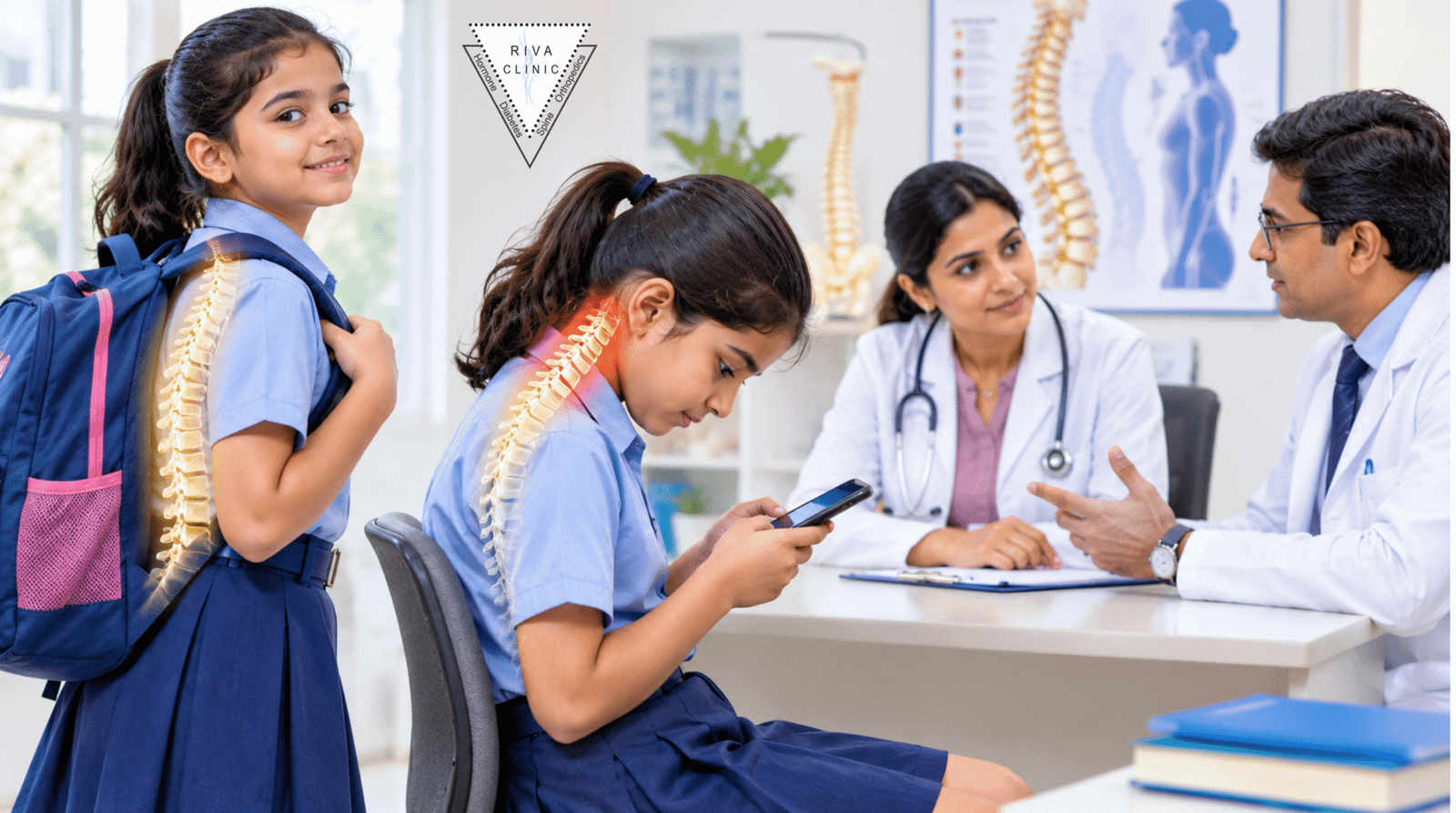
Children today spend long hours studying, carrying school bags, using smartphones, and attending online classes. While these activities are part of modern life, many parents worry about their effect on a child’s growing spine.
Can a heavy school bag damage a child’s back? Does looking down at a mobile phone cause a permanent change in neck posture? And could these habits affect spinal growth?
The answer is not always straightforward. Heavy bags and prolonged mobile use can contribute to muscle strain, neck discomfort, and back pain. However, they are not established causes of scoliosis or permanent spinal deformity.
Understanding the issue from both a paediatric endocrinology and spine care perspective can help parents protect their child’s overall health.
Can Heavy School Bags Cause Spine Problems in Children?
A school bag that is too heavy or carried incorrectly can put additional strain on a child’s back, shoulders, and neck muscles.
Children may experience:
- Back or shoulder discomfort after school.
- Neck stiffness and muscle fatigue.
- Red marks or pressure around the shoulders.
- Difficulty standing comfortably while carrying the bag.
- A tendency to lean forward to balance the weight.
The effect can depend on the bag’s weight, design, how it is carried, and how long the child wears it.
However, research has not established a clear relationship between school bag weight and the long-term development of back pain in every child. Heavy backpacks are also not considered a cause of scoliosis.
Parents should focus on reducing unnecessary weight and ensuring that the bag fits properly.
What Is the Right School Bag Weight for Children?
A practical approach is to keep a child’s fully loaded school bag around 10–15% of their body weight or lower when possible. This is a commonly used safety guideline, not a scientifically proven threshold that guarantees freedom from pain.
For example:
Child’s Body WeightPractical Bag Weight Target20 kg2–3 kg25 kg2.5–3.75 kg30 kg3–4.5 kg35 kg3.5–5.25 kg40 kg4–6 kg
If your child struggles to lift the bag, leans forward, or complains of discomfort, consider reducing the weight even if it falls within this range.
Tips for Choosing and Carrying a School Bag
Parents can follow these simple precautions:
- Choose a lightweight bag that suits the child’s height.
- Prefer wide, padded shoulder straps.
- Encourage children to use both shoulder straps.
- Keep heavier books closer to the back of the bag.
- Remove unnecessary books, toys, and other items.
- Use school lockers or digital study material where available.
- Consider a suitable wheeled bag if carrying the load is difficult and school conditions allow it.
A properly fitted bag can help distribute weight more comfortably and reduce unnecessary strain.
Can Mobile Phone Use Cause Neck and Spine Problems?
Mobile phones have become a regular part of children’s daily routines. They use them for online learning, entertainment, communication, and gaming.
The problem often arises when children look down at a screen for long periods without changing their position.
This posture can contribute to:
- Neck stiffness and discomfort.
- Shoulder muscle tension.
- Upper back pain.
- Headaches associated with neck muscle strain.
- Fatigue after prolonged screen use.
Research has found an association between prolonged mobile phone use and neck pain in children and adolescents. However, this does not prove that mobile phones directly cause permanent spinal damage.
The concern is mainly prolonged, repetitive posture and insufficient movement.
What Is Text Neck?
Text neck is a commonly used term for neck discomfort associated with repeatedly looking down at phones or other screens.
When a child bends their head forward for a long time, the muscles around the neck and upper back have to work to support the head.
Over time, this may lead to muscle fatigue and discomfort.
Parents can help by encouraging children to:
- Hold phones closer to eye level.
- Avoid bending the neck for long periods.
- Sit comfortably while using digital devices.
- Take regular breaks from screens.
- Change positions and move around frequently.
- Avoid using phones while lying awkwardly in bed.
A Paediatric Endocrinologist’s Perspective: Why Growth and Bone Health Matter
A child’s spine develops alongside the rest of the skeleton. Childhood and adolescence are important stages for bone growth, hormonal development, and physical maturation.
A paediatric and adolescent endocrinologist evaluates conditions that may affect growth, puberty, metabolism, and bone health.
From this perspective, parents should pay attention to more than posture and school bag weight.
Important factors include:
1. Healthy Growth and Development
Children grow at different rates. Regular monitoring of height, weight, and growth patterns can help identify concerns that may require medical evaluation.
2. Calcium and Vitamin D
Calcium and vitamin D are important for healthy bone development. A balanced diet, appropriate sunlight exposure, and medical advice when needed can help support bone health.
Children should not be given high-dose supplements without consulting a healthcare professional.
3. Hormonal Health
Hormonal conditions can sometimes affect growth, puberty, and bone development. If a child has unusual growth patterns, delayed puberty, or other concerning symptoms, an endocrinologist may recommend an appropriate assessment.
Important: Heavy school bags and mobile phone use do not automatically indicate a hormonal or bone-growth problem. These are separate issues that should be evaluated according to the child’s symptoms and medical history.
A Spine Surgeon’s Perspective: When Should Parents Be Concerned?
A spine specialist evaluates the bones, discs, nerves, muscles, and alignment of the spine.
Occasional discomfort after a long school day may improve with appropriate activity changes and rest. However, repeated or persistent pain deserves attention.
Parents should look out for:
- Back or neck pain that keeps returning.
- Pain that interferes with school, sports, or sleep.
- Numbness, tingling, or weakness in the arms or legs.
- Difficulty walking or maintaining balance.
- Noticeably uneven shoulders or hips.
- A visible change in spinal alignment.
- Pain following a significant fall or injury.
These symptoms do not automatically mean that a child has a serious spinal condition. However, they should be assessed by an appropriate healthcare professional.
Seek prompt medical attention for severe or worsening pain, new weakness, difficulty walking, or pain accompanied by fever or unexplained weight loss. New bladder or bowel control problems require emergency assessment.
Does Poor Posture Cause Scoliosis?
This is one of the most common concerns among parents.
Scoliosis is a condition in which the spine develops a sideways curve. It often becomes noticeable during the growth years, particularly around adolescence.
Poor posture, heavy backpacks, and mobile phone use are not established causes of idiopathic scoliosis.
Parents should not assume that a child has scoliosis simply because they slouch while studying or using a phone.
However, noticeable unevenness in the shoulders, waist, or hips should be discussed with a doctor. A clinical examination can help determine whether further assessment is needed.
How Can Parents Protect Their Child’s Spine?
Healthy daily habits can help children remain active and reduce unnecessary muscle strain.
Consider these practical steps:
- Encourage regular physical activity: Walking, cycling, swimming, and age-appropriate sports support general fitness.
- Improve study posture: Use a chair and desk that allow comfortable sitting, with the screen at a suitable height.
- Limit uninterrupted screen sessions: Encourage frequent movement breaks rather than long periods in one position.
- Check school bags regularly: Remove unnecessary items and ensure both straps are used.
- Support healthy nutrition: Provide a balanced diet with adequate calcium, protein, and other essential nutrients.
- Encourage open communication: Ask children whether they experience pain, stiffness, or difficulty during daily activities.
The aim is not to make children sit perfectly straight all day. It is to encourage comfortable movement, regular activity, and healthy habits.
Get Paediatric Endocrine and Spine Care at Riva Clinic, Pitampura
Children’s growth and spinal health are important parts of their overall development. When parents notice persistent pain, unusual growth patterns, or changes in posture, a professional evaluation can help identify the underlying concern.
At Riva Clinic, Pitampura, Delhi, Dr. Vaishakhi Rustagi, Consultant Paediatric and Adolescent Endocrinologist, provides care related to growth, puberty, hormonal conditions, and bone health.
Dr. Tarush Rustagi, Consultant Spine Surgeon, provides evaluation and treatment guidance for spinal conditions, including paediatric spine concerns.
Depending on the child’s symptoms, the appropriate specialist can recommend further assessment and an individualised care plan.
If your child has recurring back or neck discomfort, or you have concerns about their growth and bone health, book a consultation at Riva Clinic.
Clinic Address: AD 35 A, Tower Apartments, Pitampura, Near Power House, Outer Ring Road, Entry from Gate No. 1, Service Lane, Delhi – 110034.
Phone: +91 93113-41151 | +91 70421-41515
Email: contact@rivaclinic.com
Website: https://rivaclinic.com/
Frequently Asked Questions
1. Can a heavy school bag damage a child’s spine?
A heavy or poorly fitted school bag may contribute to back, shoulder, and neck discomfort. However, backpacks have not been established as a cause of scoliosis or permanent spinal deformity.
2. What percentage of body weight should a school bag be?
A commonly used practical guideline is to keep a fully loaded school bag around 10–15% of the child’s body weight or lower when possible. The child’s comfort and ability to carry the bag properly are also important.
3. Can mobile phone use cause neck pain in children?
Yes, prolonged mobile phone use, particularly while looking down for extended periods, is associated with neck discomfort in children and teenagers. Regular breaks and better screen positioning may help reduce strain.
4. Does poor posture cause scoliosis in children?
No. Poor posture is not an established cause of idiopathic scoliosis. Scoliosis is a structural spinal condition that should be assessed by a healthcare professional if changes in spinal alignment are noticed.
5. When should parents take a child to a spine specialist?
Parents should seek an assessment if back or neck pain persists, repeatedly returns, affects daily activities, or is accompanied by numbness, weakness, walking difficulties, or noticeable changes in posture.