

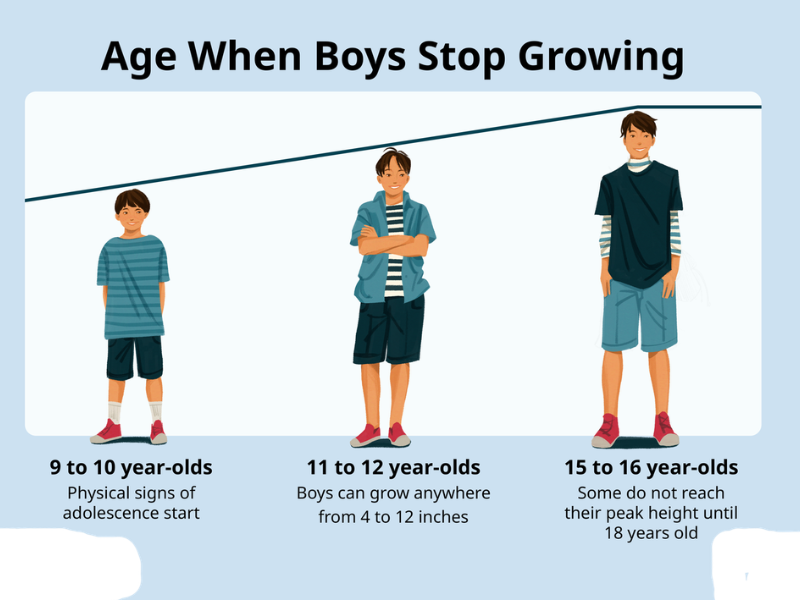
Parents often ask, “Can a child grow taller after puberty?” This is an important question, especially when a child seems shorter than expected or appears to have stopped growing.
The answer is not the same for every child. Height growth depends on several factors, including age, family height, stage of development, and whether the areas of growing bone are still active.
Many parents also hear about growth plates and bone age but may not know what they mean or how they relate to height.
Understanding these factors can help parents know what to expect and when it may be useful to seek professional guidance.
Can a Child Grow Taller After Puberty?
Yes, some growth may still be possible around or after puberty, but it depends mainly on whether the growth plates are still open.
Children generally experience their fastest height gain during certain stages of childhood and puberty. As puberty progresses, the growth plates gradually mature and eventually close.
Once these areas have completely closed, natural height growth is generally no longer possible.
However, the timing is different for every child. This is why simply looking at a child’s age may not provide the complete answer.
A proper growth assessment can help determine how much growth potential may remain.
What Are Growth Plates?
Growth plates are areas near the ends of certain bones that allow bones to become longer as a child grows.
As children mature, these areas gradually change. Toward the end of puberty, the growth plates eventually close.
This is why growth plate status is important when discussing remaining height potential.
Parents should understand that growth cannot be predicted accurately simply by looking at a child’s current height.
Other factors, including development and bone maturity, also matter.
What Is Bone Age and Why Does It Matter?
Bone age is an estimate of how mature a child’s bones are compared with the child’s actual age.
For example, a child may be 13 years old but have bone development that appears younger or older than their actual age.
This information can sometimes help a doctor understand a child’s growth pattern and whether significant growth may still be possible.
Bone age is therefore one part of a broader assessment. It should not be used alone to promise a particular final height.
5 Factors That Influence a Child’s Height Potential
1. Family Height
Genetics have a major influence on a child’s eventual height.
If parents are naturally shorter, their child may also have a shorter expected adult height. This can be completely normal.
However, family height is only one part of the overall picture.
2. Stage of Puberty
Children do not all enter or progress through puberty at the same time.
Some children begin puberty earlier, while others develop later. This difference can affect when their major growth phase occurs.
A child who enters puberty later may continue growing at an age when some of their peers have already slowed down.
Therefore, comparing children only by age can sometimes be misleading.
3. Growth Pattern
A child’s growth over time is often more informative than a single height measurement.
Parents should consider whether their child has been growing steadily or whether their height gain has slowed significantly.
If a child suddenly appears to stop growing, professional evaluation may help determine what is happening.
4. Nutrition and Overall Health
Healthy growth requires adequate nutrition and good overall health.
A balanced diet, appropriate physical activity, adequate sleep, and general wellbeing all support healthy development.
Long-term health or nutritional concerns can sometimes affect normal growth.
If parents have ongoing concerns about appetite, weight, health, or development along with height, they should discuss them with a healthcare professional.
5. Individual Growth Timing
Every child has their own growth timeline.
Some children grow earlier, while others may experience their major height gain later.
This is one reason why parents should avoid assuming that a child has finished growing simply because they have reached a certain age.
A professional assessment can provide a clearer understanding of the child’s individual situation.
How Do You Know If Your Child Still Has Growth Potential?
Parents cannot reliably determine remaining height potential simply by looking at their child’s appearance.
A doctor may consider:
- Current height
- Previous height measurements
- Growth pattern
- Age
- Stage of puberty
- Family height
- Overall health
- Development
- Bone maturity, when appropriate
Together, these factors can provide a better understanding of whether a child may continue to grow.
What If My Child Is Shorter Than Their Friends?
Being shorter than friends or classmates does not automatically mean that a child has a growth problem.
Children develop at different rates, and puberty can occur at different times.
Instead of focusing only on comparisons, parents should ask:
Is my child continuing to grow appropriately?
If the answer is unclear, a pediatric growth specialist can help evaluate the child’s growth pattern.
When Should Parents Consult a Pediatric Endocrinologist?
Parents may consider professional advice if:
- Their child’s height gain appears to have slowed.
- Their child is significantly shorter than expected.
- Puberty appears unusually early or late.
- The child has stopped growing as expected.
- There are concerns about overall development.
- Parents are worried about remaining height potential.
- The child’s growth pattern is different from other family members.
Early evaluation does not necessarily mean that a child has a serious problem.
Instead, it can give parents a clearer understanding of their child’s growth and development.
Can Height Be Increased After Growth Plates Close?
Once growth plates have completely closed, natural bone lengthening is generally no longer possible.
This is why parents should be cautious about products or claims that promise significant height increases after growth has naturally ended.
There is no single solution that can guarantee additional height for every child.
If you are concerned about your child’s remaining growth potential, it is better to seek an expert assessment rather than depend on unverified height-increasing products or advice.
Understanding Growth Potential With Dr. Vaishakhi Rustagi
If you are concerned about your child’s height, puberty, or growth pattern, Dr. Vaishakhi Rustagi at Riva Clinic, Delhi, can help parents understand their child’s individual growth concerns.
The purpose of an evaluation is not simply to focus on height. It is to understand whether the child’s growth and development are progressing appropriately and whether any further assessment may be helpful.
Parents can learn more about the clinic’s facilities and services here:
Riva Clinic Facilities & Services
If you would like to discuss your child’s growth concerns with the pediatric clinic, you can contact Riva Clinic here:
Contact Pediatric Clinic Delhi
Frequently Asked Questions
Can a child grow taller after puberty?
Some children may continue to gain height during the later stages of puberty. The amount of remaining growth depends on individual development and whether the growth plates are still open.
Can you grow taller after growth plates close?
Once the growth plates have completely closed, natural height growth is generally no longer possible.
What is bone age?
Bone age provides an estimate of how mature a child’s bones are. It can sometimes help a doctor understand growth and remaining height potential.
Does puberty stop height growth immediately?
No. Height growth does not necessarily stop as soon as puberty begins. Children generally continue growing during puberty, although the timing and amount of growth vary.